

Youth power
Youth power
I have been in a lot of rooms where the future of girls is discussed. Rarely am I in one where girls are the ones doing the discussing, leading and dancing! This spring in Côte d’Ivoire, at the 2026 Adolescent Girls Summit, over 200 adolescents and young people from 25 countries gathered to do exactly that, building an action plan to advance gender justice. Abigail, a member of the Communications Committee, captured the mood of a generation: “To my fellow young leaders: the ‘wait your turn’ era is over. Whatever your skill — law, design, storytelling — use it to build the future you want to see.” Powerful right?
In early 2021, I wrote on this blog about the impact of COVID-19 on young people, asserting our commitment at GFC to prioritise not only their needs, but their solutions. But this wasn’t a new priority; youth voice has been a central value at GFC for many years. In this post, I want to reflect on how far we have come and where we still want to go. Because listening to young people is not enough. We need to move beyond symbolic participation to structural change. As funders, we need to consider: what is the difference between being consulted and actually having power?
The problem with tokenism
There are understandable hesitations about handing decisions to young people. Some argue they lack institutional experience, that philanthropy is a sophisticated field, and that well-meaning participation can produce worse outcomes. But at GFC we have seen time and again that young people are best placed to respond to issues that affect them directly and must be centred when decisions are made about funding intended to serve them. They also need to feel safe to challenge decisions and say what they actually think to the adults who have the final say – this is very difficult to achieve in practice.
To be clear, I am not claiming adult led philanthropy has been missing issues for decades. What I am saying is that young people tend toward different solutions and different problems worth solving. And I believe we are missing a trick if we hold on to an adult-only lens.
What GFC actually means by youth voice
At GFC, youth voice means handing over power and influence to young people, not just gathering their opinions. It requires structural changes that embed young voices into governance, grantmaking, and strategy. Our Spark Fund1, Young Game Changers Fund2, and Youth Leadership Council3 are opportunities we have purposefully designed to enable young people to make key decisions about funding at GFC.
In our annual report from last year, 49% of GFC’s partners were youth-led and 70% of those youth-led groups were receiving funding for the first time. This is significant because when we consider the global challenges we face in climate, gender justice, migration, and education, we need the generation most affected to help shape solutions. Many of them already are.
At 18, Hadja Idrissa Bah founded the Club des Jeunes Filles Leaders de Guinée in Guinea, a space for girls to be heard, supported, and empowered, after finding herself confronting the reality of girls growing up in silence around gender-based violence. Seeing what she has achieved since is incredible and powerful. What makes the partnerships between GFC and youth-led organisations work is trust: the freedom to decide what support looks like in their own communities.
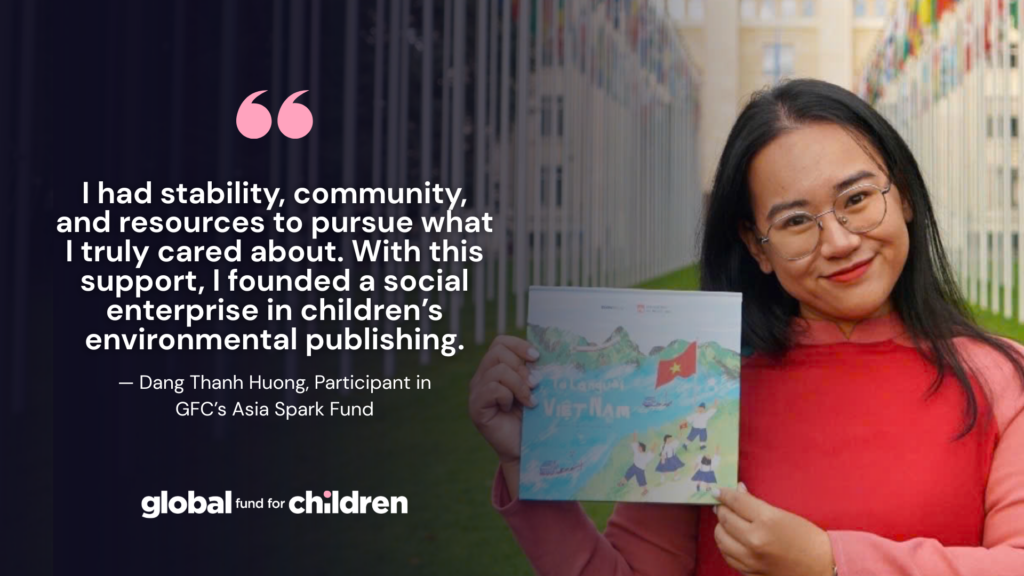
For Spark Fund grantee Huong in Vietnam, that same trust enabled her to found a social enterprise in children’s environmental publishing, produce over ten books reaching more than 15,000 readers, and be selected as one of 14 Kofi Annan Changemakers. Huong’s story shows what becomes possible when young people are resourced and trusted to lead.
Letting young people speak for themselves
Giving young people a voice also means centering their own narratives. On the GFC blog, Huong has written powerfully about the climate crisis, communicating the priorities that need urgent global attention. On Instagram, we recently featured Jaida-Jean from Milk Honey Bees in the UK, who shared how her involvement has meant finding her voice, growing in confidence, and embracing new opportunities. Young voices cut through in ways adult rhetoric often cannot, and platforming them on our digital media, but also at events and conferences, is itself an act of trust. And our content is richer as a result of the young voices who contribute.
The honest reckoning
We have not always got this right. In the Spark Fund pilot, 70% of panelists said the time commitment was appropriate, but many wanted more space for decision-making. We responded by adding a tenth design session and more deliberation time in subsequent rounds. We also adjusted the communications allowance upward and moved it to the start of the process — a small change that made a meaningful difference to participation.
We also learned that relationship-building across different nationalities is harder than it looks, particularly in virtual formats. And we learned that young people’s priorities don’t necessarily fit neatly into funder categories. After the first round, panelists identified mental health and climate action as urgent, and GFC expanded the fund accordingly. We believe that’s how it should work: the fund being shaped by the people it serves and holding space for critical reflection.
There’s been a lot to learn during the design and implementation of these initiatives, but we’re developing as an organization in how we can do this well and I’m excited about the future impact of empowering young people in new and innovative ways.
A call to the sector
Genuine youth voice asks funders to go beyond consultation and to do the structural work of involving young people in real decisions, and to create conditions where they feel safe to say what they think. When young people are trusted with that responsibility, the whole system shifts. Since my post-COVID blog story, a lot has been achieved at GFC to equip young people with decision-making power so they can be the changemakers they are often expected to be. We are determined to continue on this journey, listening and learning as we go, so more young people are centred and resourced to create a safer world.
¹The Spark Fund is a participatory grantmaking initiative by Global Fund for Children that shifts decision-making power to young people, supporting youth-led organizations to advance change in their communities.
² The Young Gamechangers Fund is a UK-based fund that provides grants to young people aged 10–25, supporting projects that create safer, more inclusive, and sustainable communities.
³ The Youth Leadership Council (YLC) is a global group of young leaders who advise GFC’s strategy, programs, and governance, ensuring youth perspectives shape organizational decisions and drive meaningful change.
Youth power
Youth power
Youth power