Building Alliances from the Communities
Editor’s note: This blog post is also available in Spanish.
What does it mean to arrive in a community with more questions than answers? What changes when the connection begins with listening rather than with the rush to intervene?
Between April and June 2025, at Global Fund for Children (GFC), we traveled through communities in Honduras and Colombia as part of the HEEL Initiative —heel, a Maya word meaning transformation and an invitation to nurture caring masculinities. We did not arrive with predesigned solutions or definitive diagnoses. We arrived with questions, with time, and with the willingness to let ourselves be transformed by the encounters.
From that journey, four new relationships emerged—relationships we celebrate today: Educate in Honduras, and Fundación Adrián Ramos, Fundación Hüaitoto, and Jóvenes Creadores del Chocó in Colombia. These are organizations deeply committed to gender justice and to the leadership of children and young people, who now join the GFC community and the HEEL Initiative.
This expansion was made possible thanks to the support of Fundación Summit and Chanel Foundation, and to a shared commitment to weaving living networks of collaboration across the region—from Mexico to Colombia—recognizing that social transformation is built from the communities, in dialogue with its histories, its wounds, and its resistances.
What are we seeking in HEEL?
At HEEL, we begin from a profound conviction: young people are key protagonists of social transformation and the pursuit of gender justice. We therefore partner with organizations where youth leadership is not symbolic but lived—shared every day—and where caring, responsible masculinities are nurtured through experience, dialogue, and community action.
We engage with processes that work with children and youth in contexts shaped by violence, inequality, racism, and the climate crisis. We choose care, dignity, and collective hope. We believe in community, and in art as a space for transformation—a space to heal, imagine, and build possible futures through creativity, sensitivity, and joy.
Arriving, listening, walking: scouting as a practice of care
For us, scouting is not just a methodology or a preliminary step before funding. It is a way of arriving, of being present, and of building trust. It means taking the time to listen, to walk the communities, and to meet the people behind the organizations. Before deciding, we research, map, talk, and ask questions. We take seriously the responsibility of learning from the contexts, struggles, and resistances of those we accompany.
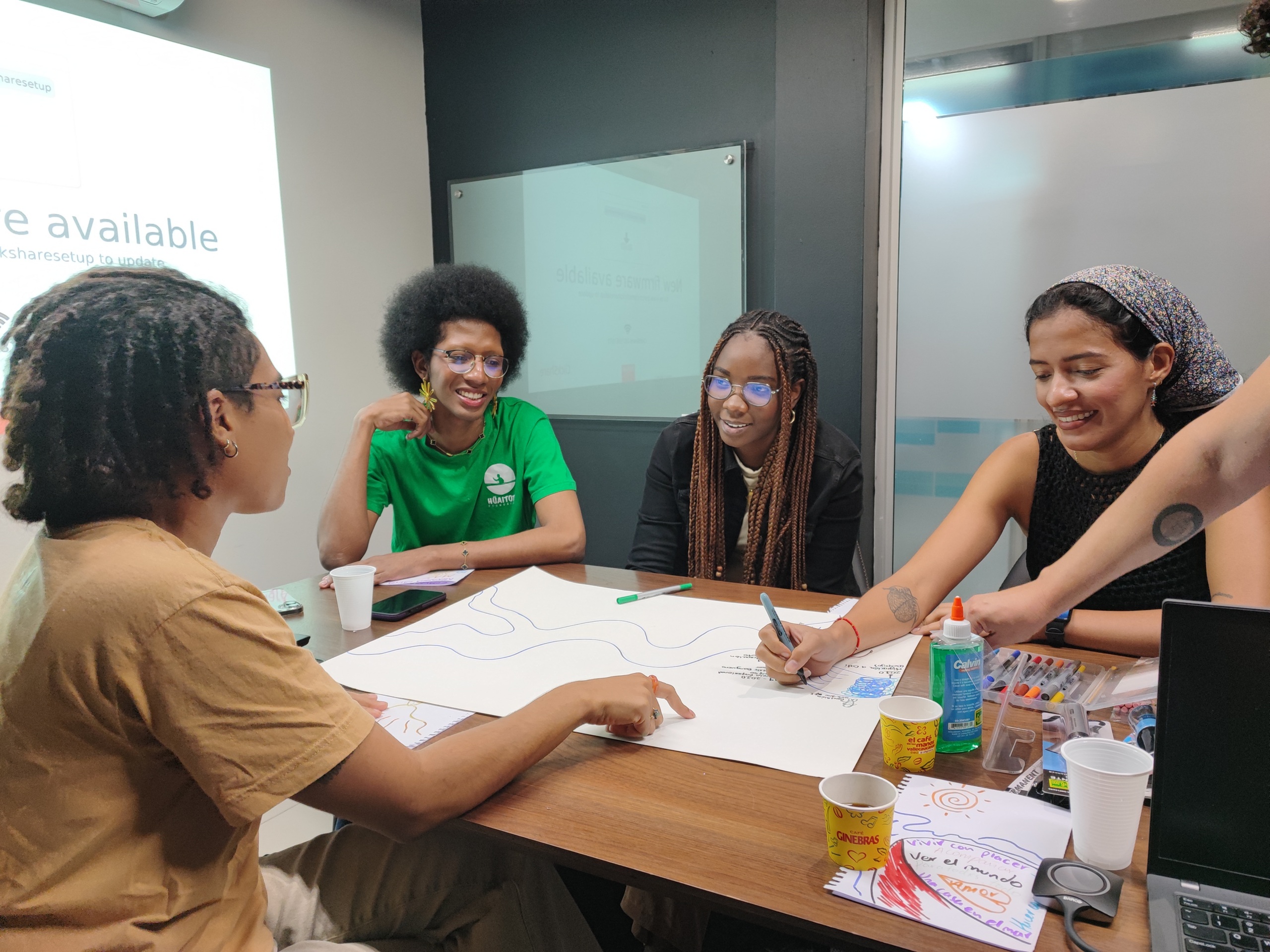
Within HEEL, this process had a particular meaning: strengthening a regional and intersectional perspective, recognizing that masculinities are lived and shaped differently in each context, and that they are profoundly marked by race, gender, violence, and the social and political conditions of every community.
During this process, we identified nearly 30 community organizations; we conducted remote interviews with several of them and later visited 11 in the field. Each encounter expanded our perspective. Each conversation left an imprint. And it was there, in the shared region, that we confirmed something essential: transformation does not begin with a formal agreement but with the simple, profound act of meeting one another as people.
Communities that teach: learning from shared experience
Walking this places was, above all, a learning experience. From the cold mountains of Bogotá to the salty mist of Bahía Málaga; from the persistent rain in Quibdó to the Honduran Caribbean, we confirmed something essential: every struggle is part of a larger map, and every community has its own way of teaching, caring, and resisting.
In Trinidad, Santa Bárbara, Honduras, we met Educate, an organization that transformed an abandoned municipal building into a vibrant space for learning, art, sports, and technology. Listening to the young people who grew up there—and who now sustain the project—showed us that leadership cannot be decreed; it is built with time, trust, and presence. There, we learned that educational and gender justice take root when young people not only participate but also decide, care, and take ownership of collective processes.
“For us, it has been an experience that has deeply moved and strengthened us. This alliance opens up new ways of understanding and working on healthy masculinities with young people, and allows us to learn alongside organizations within and beyond Honduras that have enriched us from the very beginning. We have felt genuine support, both through in-person visits and remote accompaniment, and that has pushed us to grow, to question ourselves, and to improve our processes.”- Educate NGO
In Quibdó, with Jóvenes Creadores del Chocó, learning happened through the body. Trying to dance alongside the young people—overcoming embarrassment, adult stiffness, and the fear of making mistakes—was a lesson in humility and trust. There we understood that art does more than communicate: it frees, heals, and challenges narratives of violence. Dance, music, and movement become languages for healing collective pain and imagining possible futures rooted in Afro-descendant pride and joy.
In Villa Rica, Valle del Cauca, Fundación Adrián Ramos showed us that hope is also built through emotional care and territorial rootedness. Through football, dance, and agroecology, children and youth find refuge and meaning in a community marked by violence. We learned that accompanying them means supporting integral processes where body, land, and emotion are in constant dialogue.
In Bahía Málaga, sharing a meal of fresh fish with Fundación Hüaitoto was also an invitation to listen to a living history of struggle and resistance. Through Luisa, its founder, we learned about her grandmother—a Black woman whose way of caring, organizing, and sustaining community life still shapes the lives of youth in the community. In that shared meal, we understood that care is not an abstract concept or an institutional discourse; it is a daily practice, inherited and deeply political, rooted in memory and affection.
“Our experience as a foundation within the HEEL Initiative shows us that it is possible to develop learning processes and exchanges from a place of horizontality—recognizing and understanding the contexts and the multiple intersections that shape the different processes within the initiative. At Hüaitoto, we value being able to carry out place-based learning processes aligned with our mission, our community, and the realities of the children and youth who are part of the foundation.” – Fundación Hüaitoto
These learnings did not come from structured interviews or technical reports but from shared experience: eating together, listening to family stories, moving our bodies, walking in the rain, and letting ourselves be affected by what happens to the people from this community. There, we confirmed that transformation begins when we allow ourselves to learn through relationship.
What comes next: dreams and new paths beginning
Once integrated into HEEL, the organizations began a process of accompaniment and holistic strengthening through the MIO (Organizational Impact Map) methodology. This space allowed them to look inward, recognize their capacities, and clarify the impact they aspire to build in their communities.
This process had a key moment in November, during the HEEL partners gathering in Cali, where the new organizations met the initiative’s broader network for the first time. It was a space to recognize one another, share trajectories, name shared challenges, and understand themselves as part of the same regional fabric. There, HEEL stopped being just an initiative and became a living community—sustained by relationships, shared learning, and a collective commitment to care and gender justice.
For us at Global Fund for Children, this is not only about funding initiatives. It is about walking together—building relationships based on trust, flexibility, and mutual care, and supporting processes that strengthen the autonomy, agency, and life projects of children and youth.
Today, we joyfully celebrate Educate, Fundación Hüaitoto, Jóvenes Creadores del Chocó, and Fundación Adrián Ramos as part of the HEEL Initiative and the GFC community. Their paths remind us that transformation is built in the everyday—when care, listening, and commitment become shared practice.